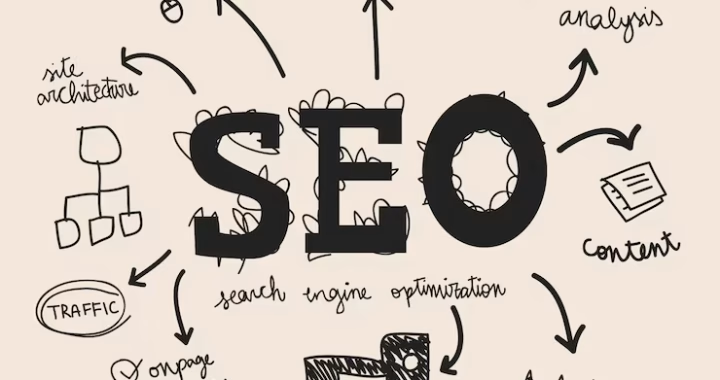

Search Engine Optimization (SEO) has always evolved alongs
ide technology, but 2026 marks one of the most significant shifts in the history of digital marketing. Artificial Intelligence (AI) is no
longer just a tool for automation—it has become a core part of how search engines understand, rank, and deliver content to users. Businesses that adapt to these changes are gaining a competitive advantage, while those relying on outdated SEO strategies risk losing visibility.
In this blog, we will explore how AI is changing SEO in 2026, what these changes mean for businesses, and how marketers can adjust their strategies to achieve better rankings and online growth.
Understanding the Relationship Between AI and SEO
AI refers to technologies that can analyze data, learn patterns, and make decisions with minimal human intervention. Search engines now use advanced AI models to understand user intent, interpret content, and provide more relevant search results.
Unlike traditional search algorithms that relied heavily on exact keyword matching, AI-powered search engines can understand context, meaning, and user behavior. This allows them to deliver more accurate and personalized results.
As a result, SEO is no longer just about inserting keyw
ords into content. It is now about creating valuable, user-focused content that genuinely answers search queries.
The Rise of AI-Powered Search
Search engines have become significantly smarter in recent years. AI-driven systems can now analyze:
User intent
Search history
Content relevance
Website authority
User engagement metrics
Contextual meaning of words
When someone searches for information, search engine
s can interpret the purpose behind the query instead of simply matching keywords.
For example, if a user searches for “best laptop for graphic design,” AI understands that the person wants recommendations, comparisons, pricing information, and performance insights rather than a page repeatedly using the exact phrase.
This shift means businesses must focus on creating comprehensive and helpful content.
Content Quality Matters More Than Ever
One of the biggest impacts of AI on SEO is the increased importance of content quality.
AI-powered search engines are designed to identify content that genuinely helps users. They can analyze factors such as:
Content depth
Readability
Accuracy
Originality
User engagement
Expertise demonstrated within the content
Low-quality articles written solely to target keywords are becoming less effective. Instead, detailed, informative, and well-structured content performs better.
Businesses should focus on:
Solving user problems
Providing actionable information
Including examples and case studies
Keeping content updated
Demonstrating expertise
The goal is to become a trusted source of information rather than simply targeting search terms.
User Intent Has Become a Ranking Priority
AI allows search engines to better understand why a user performs a search.
Search intent generally falls into four categories:
Informational Intent
Users want information.
Example:
What is SEO?
How does AI work?
Navigational Intent
Users want to find a specific website.
Example:
Facebook login
YouTube homepage
Commercial Intent
Users are researching before making a purchase.
Example:
Best smartphones under ₹30,000
Transactional Intent
Users are ready to buy.
Example:
Buy laptop online
In 2026, successful SEO strategies focus on matching content with the correct search intent. Content that aligns with user expectations is more likely to rank well.
AI-Generated Content and SEO
AI writing tools have become increasingly popular among marketers and content creators.
These tools can help with:
- Content ideation
- Blog outlines
- Keyword suggestions
- Draft creation
- Content optimization
However, AI-generated content alone is not enough.
Search engines prioritize content that demonstrates expertise, experience, and originality. Businesses should use AI as an assistant rather than a replacement for human creativity.
The most successful approach combines AI efficiency with human editing, insights, and industry knowledge.
Voice Search Continues to Grow
Voice assistants and smart devices have made voice search more common tha
n ever.
People tend to use longer and more conversational phrases when speaking compared to typing.
For example:
Typed Search:
- Best digital marketing agency
Voice Search:
- Which is the best digital marketing agency for small businesses near me?
To optimize for voice search, businesses should:
- Use natural language
- Include conversational phrases
- Answer common questions
- Create FAQ sections
- Target long-tail keywords
AI helps search engines understand these conversational queries more accurately.
Personalized Search Results
AI enables search engines to provide personalized experiences for users.
Search results may vary based on:
- Location
- Device
- Search history
- User preferences
- Previous interactions
This means businesses must focus on serving diverse audience needs rather than relying on a single keyword strategy.
Local SEO becomes increasingly important because search engines prioritize nearby and relevant businesses for location-based searches.
Predictive SEO Is Emerging
AI can identify trends before they become mainstream.
Predictive SEO uses data analysis to anticipate:
- Future search trends
- Seasonal demand
- Emerging topics
- Consumer interests
Businesses that publish content early on trending topics often gain a ranking advantage.
Marketers can use AI-powered tools to discover opportunities before competitors recognize them.

Improved Keyword Research
Traditional keyword research focused on search volume and competition.
In 2026, AI-powered keyword research tools provide deeper insights such as:
- User intent
- Semantic relationships
- Content gaps
- Trending topics
- Related questions
Instead of targeting a single keyword, businesses should create content around broader topic clusters.
This helps establish topical authority and improves search visibility.
Better Technical SEO Through AI
Technical SEO remains important, and AI is making it easier to manage.
Modern AI tools can automatically identify:
- Broken links
- Slow-loading pages
- Crawl errors
- Duplicate content
- Mobile usability issues
- Indexing problems
This allows businesses to fix technical issues faster and improve website performance.
Since user experience remains a major ranking factor, technical optimization continues to play a critical role in SEO success.
The Importance of E-E-A-T
Search engines increasingly evaluate content using E-E-A-T principles:
Experience
Has the author actually used or experienced the topic?
Expertise
Does the author have relevant knowledge?
Authoritativeness
Is the website recognized as a trusted source?
Trustworthiness
Can users rely on the information?
AI systems are becoming better at evaluating these signals.
Businesses should showcase:
- Author credentials
- Customer testimonials
- Case studies
- Industry expertise
- Reliable sources
Strong E-E-A-T signals can significantly improve rankings and credibility.
Visual Search Is Growing
AI-powered visual search technology allows users to search using images instead of text.
Businesses can optimize for visual search by:
- Using high-quality images
- Adding descriptive file names
- Including alt text
- Compressing images for speed
- Using structured data
Visual SEO is becoming an important component of modern search strategies.
How Businesses Should Adapt Their SEO Strategy
To remain competitive in 2026, businesses should focus on:
Create Helpful Content
Prioritize value over keyword stuffing.
Focus on User Experience
Improve website speed, navigation, and mobile usability.
Use AI Responsibly
Combine AI tools with human expertise.
Build Authority
Publish original insights and industry knowledge.
Optimize for Voice Search
Target conversational keywords and questions.
Invest in Local SEO
Optimize business profiles and location-based content.
Monitor Emerging Trends
Use AI-driven tools to identify new opportunities.
Conclusion
Artificial Intelligence is transforming SEO at an unprecedented pace. Search engines are becoming smarter, user expectations are increasing, and content quality matters more than ever before. The days of ranking through keyword stuffing and outdated tactics are rapidly disappearing.
Businesses that embrace AI-driven SEO strategies can improve visibility, attract qualified traffic, and build stronger relationships with their audiences. Success in 2026 depends on creating valuable content, understanding user intent, delivering excellent user experiences, and using AI as a tool to enhance—not replace—human expertise.
As AI continues to reshape the digital landscape, organizations that adapt quickly will be best positioned to achieve long-term growth and maintain a strong presence in search results.
Meta Description: Learn how AI is changing SEO in 2026, from content creation and voice search to user intent, E-E-A-T, predictive SEO, and smarter search engine algorithms.p